Urban Eco-Spire
Metallic AI Tree for City Boulevards
Urban Eco-Spire is an artificial, AI-powered tree with a natural metal finish.
It harvests water directly from humid air, stores it in a visible base tank, and irrigates nearby plants
using an intelligent control system. From a distance, it reads as a sculptural “urban tree;”
up close, it reveals a living technical heart.
Artificial tree – metallic appearance, natural presence.
Atmospheric water generator integrated into the trunk.
AI-controlled sprinkler irrigation around the base.
Designed for boulevards, promenades and plazas.
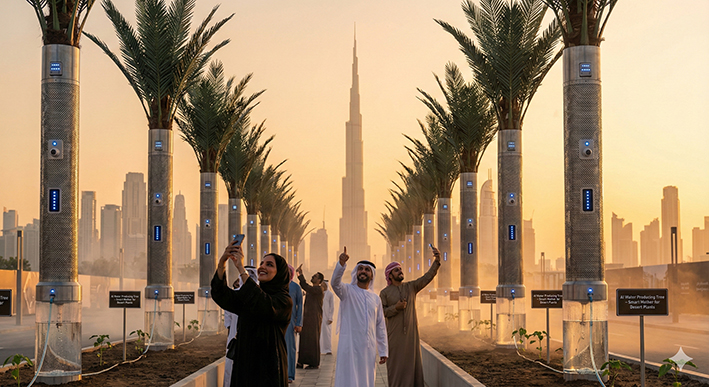
Concept scene – Urban Eco-Spire trees installed along a desert boulevard, capturing water from air and cooling the street.
System Design – Conceptual Schematic
Think of Urban Eco-Spire as a vertical stack of functional layers:
air intake at the top, water production and intelligence in the middle,
and irrigation & plants at the base.
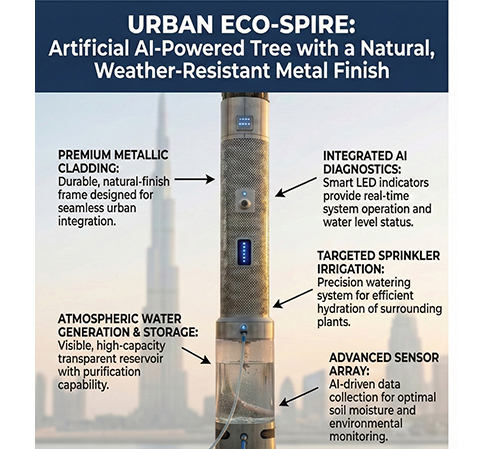
Catalog-style overview of Urban Eco-Spire – highlighting metallic cladding, AI diagnostics, atmospheric water generation and sensor array.
A · Crown & Intake
Discrete air inlets and protective grilles are integrated into the upper body of the spire.
Optional filters protect the condenser from dust and sand.
B · Condenser & Reservoir
The core cooling module condenses humidity into water, which drips into a transparent base reservoir.
The tank is visible to the public as a “proof of water-from-air”.
C · Sensors, AI & Irrigation
Soil-moisture and climate sensors feed data to the AI controller.
The controller activates pumps and valves to irrigate a circular zone of plants around the spire.
High-Level Block Diagram (Text)
[Air Intake & Fans]
        │
        ▼
[Filter + Dust Protection]
        │
        ▼
[Cooling / Condenser Module]  ←  [Air Temp & Humidity Sensor]
        │
        ▼
[Transparent Water Reservoir]
        │
        ▼
[Pump & Valve Manifold]  ←  [Soil Moisture Sensors around the spire]
        │
        ▼
[Sprinkler Ring A]      [Sprinkler Ring B]
   (left plants)           (right plants)


[MCU + AI Controller]
  • Reads sensors (air + soil)
  • Decides when to run condenser & pumps
  • Logs data and sends it wirelessly to the central platform
You can convert this text diagram into a clean, isometric infographic or 3D animated schematic for the catalog and film.
Circuit Concept (Prototype Level)
The first prototype can be built using a low-voltage DC system with a microcontroller,
MOSFET drivers and modular sensors. Below is a simplified circuit concept
(suitable for an Arduino/AVR-based test).
12–24 V DC input for condenser, fan and pumps.
Buck converter down to 5 V for MCU and sensors.
MCU (e.g. ATmega / ESP32) with Wi-Fi option.
Soil moisture sensors (capacitive) on A0, A1, …
Temp/Humidity sensor (DHT22 or SHT3x) for air.
MOSFETs driving:
condenser module, fan, pump A, pump B.
Text-Based Circuit Sketch
[12–24 V DC] ─────────────────────────────┐
                                         │
                         +───────────────┴─────────────+
                         │ Buck (Step-down) 5 V Output │
                         +───────────────┬─────────────+
                                         │
                             +-----------+---------+
                             │                     │
                          [MCU 5 V]          [Sensors 5 V]
                             │                     │
      ┌──────────────────────┼─────────────────────┘
      │                      │
  [PWM D5]               [Analog A0..A3]
   to Gate M1            soil moisture, etc.
   (Condenser + Fan)

  [D6] → Gate M2 (Pump A – sprinkler ring 1)
  [D7] → Gate M3 (Pump B – sprinkler ring 2)

Each MOSFET:
  Source → GND
  Drain → negative terminal of load
  Load positive → +12–24 V
  Gate → MCU pin via 220–330 Ω resistor
  Gate → GND via 10 kΩ pull-down
  Diode across each inductive load (pump/fan).
This is not a final industrial schematic — it’s a clear starting point you can hand to an engineer
or show in an animation explaining how the “metal tree” works inside.
Video Concept – Urban Eco-Spire
Use this as a brief for a 8-10 second cinematic video focusing only on the Urban Eco-Spire model.
Cinematic Brief
The camera flies over a hot, empty boulevard in a desert city at noon.
Heat haze dances over the asphalt. Then, we cut to the same boulevard
transformed: a row of metallic Urban Eco-Spires lines the center.
As the camera glides past, we see tiny droplets condensing inside the transparent base tanks.
The sprinklers activate in slow motion, sending arcs of water towards the plants on both sides.
LED indicators pulse softly as the AI “thinks”.
The film briefly cuts to a simplified X-ray view of one spire: a vertical schematic showing air intake,
condenser, reservoir and irrigation. We end with a wide shot of people walking in the shade,
while a final title appears: Urban Eco-Spire – AI Water Producing Tree for Desert Boulevards.
Flow Prompts – Urban Eco-Spire
These prompts are designed for 8-minute spoken Flow sessions (English voice) focused only on this model.
You can read them yourself or feed them to a model to generate scripts.
Flow 01 – “A Day in the Life of a Metallic Tree”
Imagine the Urban Eco-Spire as a living character. In 8 minutes, describe one full day from its point of view:
the heat of the morning, the moment humidity rises, the feeling of water forming inside its core,
the joy of spraying plants, and the quiet night when it watches the city lights. Focus on sensory details:
sound of fans, shimmer of droplets, footsteps of people passing by.
Flow 02 – “Technical Story for a City Engineer”
Speak as if you’re presenting Urban Eco-Spire to a city engineer who has no time for poetry.
In 8 minutes, explain clearly: how water-from-air works, what the main circuit blocks are,
how the AI uses sensor data, and what maintenance looks like. End by summarizing in one sentence
why this metallic tree is easier to manage than a real tree in a 45°C boulevard.
Flow 03 – “From Prototype to City-Scale Network”
Start from a single prototype in a lab or workshop. In 8 minutes, imagine the journey of Urban Eco-Spire
becoming a network of hundreds of units across a city. Describe the steps: first test installation,
data collection, AI improvements, public reaction, and finally a map showing many spires connected
as one “urban nervous system” caring for plants.
Flow 04 – “Investor-Focused Narrative”
In 8 minutes, tell the Urban Eco-Spire story for an investor audience:
the problem in desert cities, the concept of artificial trees that look natural,
the business model (hardware + service + data), and the visual impact.
End with a clear ask: what kind of partner or funding you are looking for to build the first line of spires
in a real boulevard.
Discuss Urban Eco-Spire
For engineering collaboration, city pilots or visual development (film, catalog, renders),
get in touch directly: