🏝️ Oasis Palm System
Contact

Model 02 Β· AI Water Producing Tree

Oasis Palm System Artificial Mother Tree for Young Plants

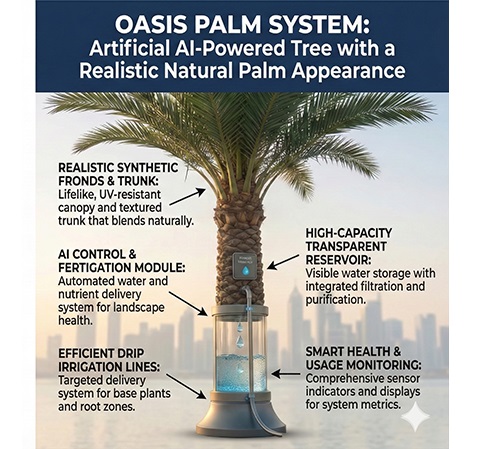
Oasis Palm System is an artificial palm-style AI tree that behaves like a mother for nearby plants. It pulls water from humid air, stores it in a transparent base, adds fertilizer when needed, protects soil with shade and delivers water directly to the roots. From far away it looks like a normal palm; only when you get close you see the transparent tank and the intelligent heart inside.

  • Artificial palm – realistic trunk and fronds, but fully technical inside.
  • Water-from-air condensation visible in the base tank.
  • Smart fertilizer module for micro-dosing nutrients.
  • Drip irrigation directly to the root zone of young plants.
Boulevard lined with AI water producing palm trees in a desert city
Oasis Palm System technical infographic

Top: how the system can look inside a real boulevard or resort.
Left: infographic explaining the internal modules of the Oasis Palm System (water-from-air, reservoir, fertigation and smart monitoring).

System Design – Mother Tree Behaviour

In this model, the AI behaves like a caregiver: it pays attention to small plants and seedlings around the palm, deciding when to provide shade, water and nutrients.

A Β· Palm Canopy & Shade

Realistic synthetic fronds create shade zones that reduce evaporation and soil temperature, protecting small plants as they grow.

B Β· Condenser, Reservoir & Fertilizer

The trunk hides the atmospheric condenser and a transparent base tank. A small cartridge injects fertilizer into the water line when the AI decides it is needed.

C Β· Root-Zone Drip Network

Thin drip lines run underground around the palm, delivering water directly to the root zones of each young plant, with individual control per zone.

Text-Based β€œCutaway” Diagram

Top:
  [Palm Canopy – Synthetic Fronds]
      β”‚   (shade + optional solar ring)
      β–Ό
Middle:
  [Air Intake + Filter] β†’ [Condenser Module]
      β”‚                       β”‚
      β”‚                   (Water droplets)
      β–Ό                       β–Ό
Base:
  [Transparent Reservoir] ← [Droplet Collector]
      β”‚
      β”œβ”€β†’ [Fertilizer Cartridge + Micro-pump]
      β”‚
      └─→ [Drip Lines A/B/C] β†’ [Plant Root Zones]

Sensors:
  - Soil moisture probes at each plant area
  - Air temp/humidity sensor at mid-height
  - Optional light sensor (sun intensity)

AI Logic:
  - If humidity + temperature suitable β†’ run condenser
  - If soil dry in zone A/B/C β†’ open drip valve for that zone
  - Occasionally mix fertilizer when plants are young or depleted.
        

This diagram can be turned into a beautiful, vertical infographic: half natural palm, half transparent technical view.

Circuit Concept with Fertigation

The electronic architecture is similar to Urban Eco-Spire, with one important addition: a controlled fertilizer pump or valve.

  • 12–24 V DC bus for condenser, fan, water pump and fertilizer pump.
  • 5 V bus via buck converter for MCU and sensors.
  • MCU / AI module (ESP32 or similar) with enough I/O for multiple drip zones.
  • Soil moisture sensors in 3–4 planting cells.
  • Dedicated MOSFET for the fertilizer micro-pump.

Text-Based Circuit Sketch

[12–24 V DC] ────────────────────────────────────────┐
                                                    β”‚
                           +────────────────────────┴────────────+
                           β”‚   Buck Converter β†’ 5 V (logic)      β”‚
                           +────────────────────────┬────────────+
                                                    β”‚
                      +-----------------------------+-------------------------+
                      β”‚                                                       β”‚
                [MCU / ESP32 5 V]                                 [Sensors 5 V]
                      β”‚                                                       β”‚
      β”Œβ”€β”€β”€β”€β”€β”€β”€β”€β”€β”€β”€β”€β”€β”€β”€β”Όβ”€β”€β”€β”€β”€β”€β”€β”€β”€β”€β”€β”€β”€β”€β”€β”€β”€β”€β”€β”€β”€β”€β”¬β”€β”€β”€β”€β”€β”€β”€β”€β”€β”€β”€β”€β”€β”€β”€β”€β”€β”€β”€β”€β”€β”€β”¬β”€β”€β”€β”€β”€β”€β”€β”€β”€β”˜
      β”‚               β”‚                      β”‚                      β”‚
  [PWM D5]        [D6] (Pump Water)     [D7] (Pump Fertilizer)  [D8..D10] (Valves)
 to Gate M1       β†’ Gate M2             β†’ Gate M3               β†’ Gates M4..M6
 (Condenser+Fan)

Analog Inputs:
  A0..A3 β†’ Soil Moisture (Zones A/B/C/D)
  A4     β†’ Reservoir Level (float / capacitive)
  D2     β†’ Air Temp/Humidity (DHT/SHT)

Each MOSFET: N-channel, logic-level
  Source β†’ GND
  Drain  β†’ negative terminal of load
  Load + β†’ 12–24 V
  Gate   β†’ MCU pin via 220–330 Ξ© resistor
  Gate   β†’ GND via 10 kΞ© pull-down
  Diode across each inductive load (pump/fan/valve).
        

This is a clear prototype-level plan, ready for a first PCB and for visual explanation in your film or animated catalog.

Video – Oasis Palm System in Action

This short clip shows how an entire boulevard can be transformed by AI water-producing palms: harvesting water from air, feeding young plants and turning hot streets into shaded green corridors.

The same core idea can scale to **desert highways, resorts and even future AI forests**, working together with natural trees to prevent fires and protect life.

Replace Oasis_Palm_System.mp4 with the final exported clip in the same folder on your server.

Discuss Oasis Palm System

For oasis projects, resorts, artificial forests or research sites, contact us for collaboration and co-design:

WhatsApp